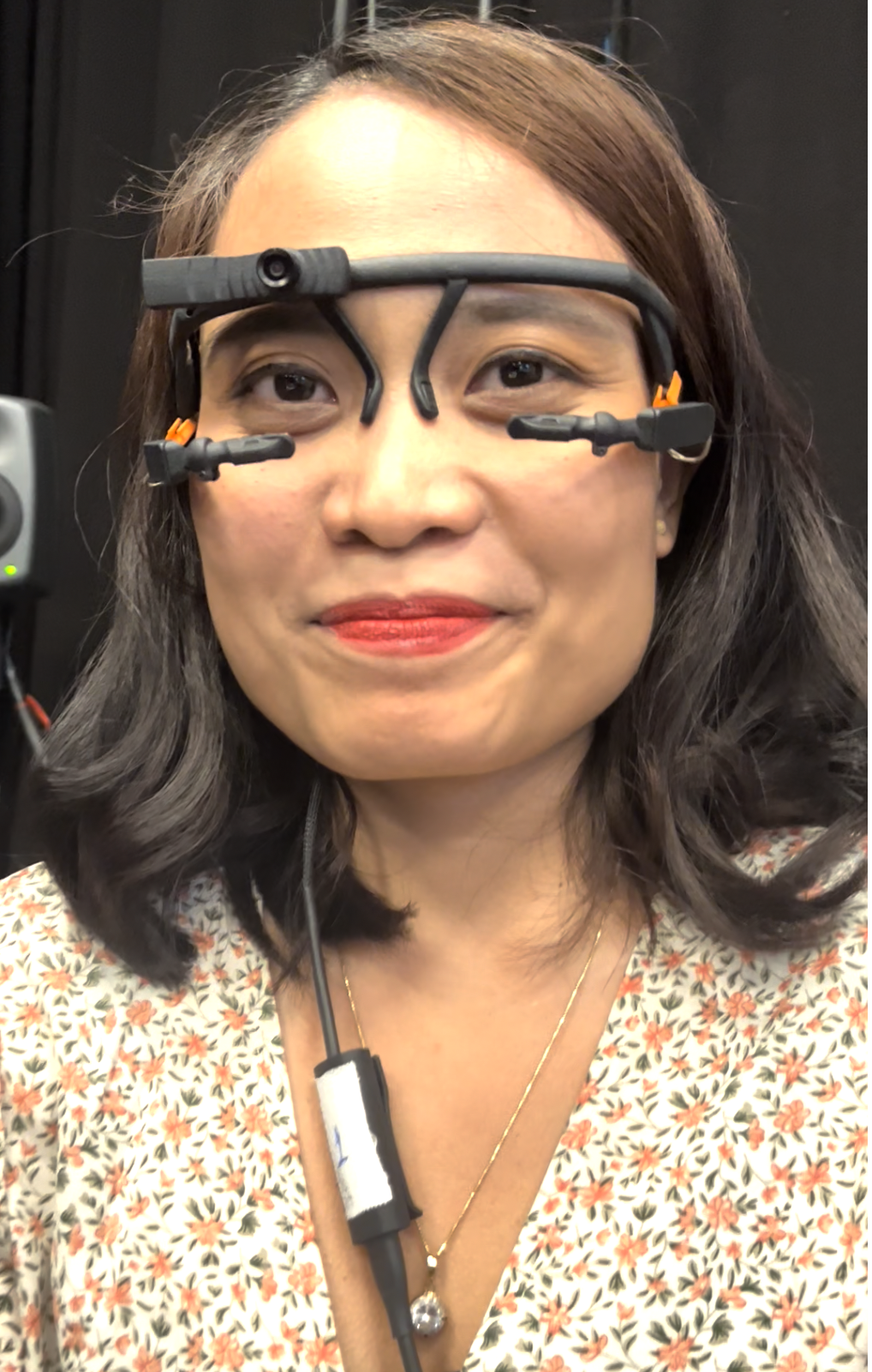
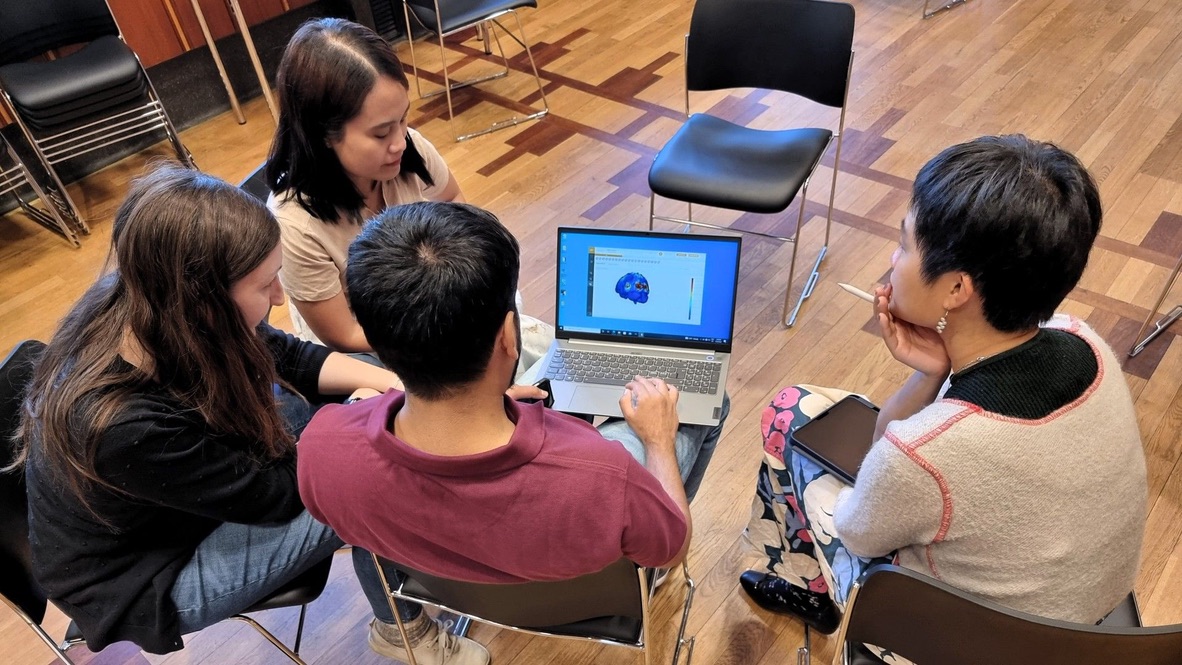
Embodied cognitive science conceptualizes bodily activity as part of cognitive dynamics. I work with multimodal data (including movement and eye tracking, speech, video, electrodermal activity, sensor and touchscreen data) to empirically test this view. I draw upon nonlinear methods like Recurrence Quantification Analysis, new to education research, that can capture the complex dynamics of learning data. I apply these methods to study changing coordinations of bodily and ecological resources as learning, such as the emergence of new ways of looking and acting preceding conceptual breakthroughs in problem-solving.

Relevant Publications
Abrahamson, D., Tancredi S., Xiao, Z., Weiss, M., Potęga vel Żabik, K., & Dimmel, J. (under review). It’s our move: Mathematical perception emerges for coordinating joint action.
Zhang, F. & Tancredi, S. (2025). Predicting electrodermal activity from conceptual and physical activity in an embodied learning environment. Proceedings of the Cognitive Science Society 2025 (Cogsci 2025) (Vol. “Posters”). San Francisco, CA.
Sar-Israel, M., Zhang, F. E., Liu, Y., & Tancredi, S. (2024). Tracking sensory regulation during embodied learning with electrodermal activity. Proceedings of the 18th International Conference of the Learning Sciences – ICLS 2024 (Vol. “Short papers”). International Society for the Learning Sciences (ISLS), Buffalo, NY. https://doi.org/10.22318/icls2024.908961
Abdu, R., Tancredi, S., Abrahamson, D., & Balasubramaniam, R. (2023). A complex systems outlook on hand-eye coordination in mathematical learning. In M. Schindler, A. Shvarts, & A. Lilienthal. (Eds.), Eye-tracking research in mathematics education [Special issue]. Educational Studies in Mathematics.
Tancredi, S., Abdu, R., Balasubramaniam, R., & Abrahamson, D. (2022). Intermodality in multimodal learning analytics for cognitive theory development: A case from embodied design for mathematics learning. In M. Giannakos, D. Spikol, D. Di Mitri, K. Sharma, X. Ochoa, & R. Hammad (Eds.), Multimodal learning analytics. Springer.
Tancredi, S., Abdu, R., Abrahamson, D., & Balasubramaniam, R. (2021, 2021/04/03/). Modeling nonlinear dynamics of fluency development in an embodied-design mathematics learning environment with Recurrence Quantification Analysis. International Journal of Child-Computer Interaction, 100297. https://doi.org/10.1016/j.ijcci.2021.100297
 Sofia Tancredi